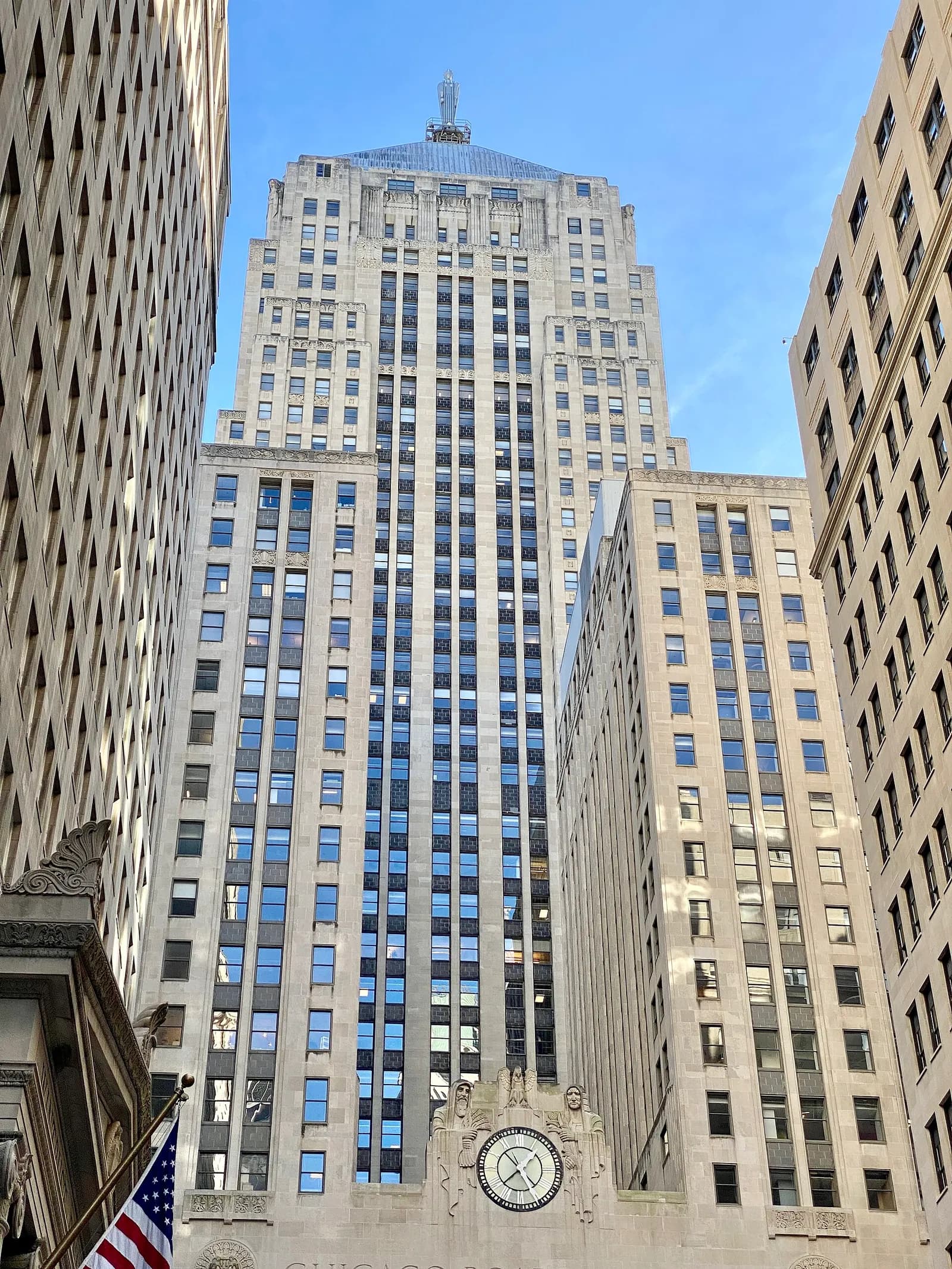
The building that anchors Gotham's financial district — looming over the street where a semi-trailer flips end over end — is the Chicago Board of Trade Building, at the foot of LaSalle Street in Chicago's Loop. Christopher Nolan shot the great majority of The Dark Knight's exteriors in Chicago, largely without disguising the city's own architecture and street grid.
This is unusual for a superhero film. Gotham is traditionally a composite fiction, built from studio backlots and digital extension. Nolan's Gotham, across his trilogy, is instead a real American city photographed as itself, with Chicago's actual skyline, actual streets and actual civic buildings doing most of the work.
LaSalle Street and the truck flip
The Chicago Board of Trade Building, an Art Deco skyscraper completed in 1930 at the south end of LaSalle Street, sits at the head of Chicago's traditional financial canyon — a straight corridor of banks and trading houses that the production used essentially unaltered as Gotham's financial district.
The sequence in which the Joker's crew flips a semi-trailer truck end over end was filmed on LaSalle Street itself, and it is a real flip rather than a digital one. A piston loaded with an explosive charge was mounted under the trailer; when it fired, a steel ram slammed into the road hard enough to throw the trailer up and over the cab. Stunt driver Jim Wilkey was inside a reinforced cab, driving and triggering it himself, and he could only fire it at one of a couple of marked points on the street where there was nothing underground to destroy. There was a single rehearsal, on a runway.
The street closures for filming were extensive and widely covered locally at the time; Chicago's film office worked closely with the production, and the city's willingness to shut down a working financial district for weeks of filming reflects how central Chicago-as-location became to the trilogy's identity, and to the city's film economy since.
Other Chicago landmarks in the film
Wacker Drive, the double-decked road running along the Chicago River, appears repeatedly, including in the Batpod chase sequences. The Richard J. Daley Center's Picasso sculpture and the surrounding civic plaza feature in exterior scenes. Chicago's distinctive elevated 'L' train and river-level lower roads gave Nolan the vertical, layered street geography that makes Gotham feel simultaneously grand and claustrophobic.
Interiors were more mixed: some were shot on soundstages in Chicago and at Cardington Studios in England. Gotham General Hospital was the derelict Brach's Confections candy factory at 401 North Cicero Avenue on the West Side — a real, empty building already condemned, which the production genuinely blew up rather than faking. Heath Ledger's Joker ambling out and stopping when the detonator appears to fail is a happy accident of the timing on a demolition that could only be attempted once.
The Gotham City name is a longstanding pseudonym for New York in the Batman comics, but Nolan's films deliberately break from that convention — his Gotham is legibly Chicago, down to details a Chicago resident would recognise on sight (street names, the river's bend, specific building silhouettes) that a generalised backlot city could never reproduce.
Why Chicago, and what it did for the city
Nolan has cited Chicago's mix of Art Deco grandeur, brutalist civic architecture and a genuinely three-dimensional street plan — elevated tracks, street level, and lower-level roads along the river — as giving Gotham a scale and menace that a studio backlot could not match.
The trilogy's extensive location shooting, alongside other major productions, helped establish Chicago as a serious American filming hub in the 2000s, with the city's film office and unions building infrastructure and relationships that outlasted the Batman films themselves.
Visiting the location
- Where
- Chicago Board of Trade Building, 141 West Jackson Boulevard, at the foot of LaSalle Street, Chicago, Illinois.
- Getting there
- In the heart of the Loop, walkable from any downtown Chicago 'L' station; LaSalle Street station is directly adjacent.
- Access
- The building's exterior and the surrounding streets are public and free to walk. The Board of Trade's trading floor is not generally open to casual visitors.
- Walk north up LaSalle Street from the Board of Trade building for the canyon view used repeatedly in the film.
- Wacker Drive along the river is a short walk away and shows the double-decked road structure used in the Batpod chases.
- The Chicago riverwalk gives the clearest sense of the layered, multi-level streets Nolan used for Gotham's geography.
- A weekday during trading hours gives the fullest sense of the financial district as a working place, closer to how the crew found it.
Frequently asked questions
Is Gotham City actually Chicago in The Dark Knight?
Largely yes. Christopher Nolan shot most exteriors in Chicago, using the city's real streets, skyline and civic architecture with comparatively little disguising, unlike most cinematic versions of Gotham.
Where was the truck-flip scene filmed?
On LaSalle Street in Chicago's Loop, near the Chicago Board of Trade Building, using a practically rigged stunt truck rather than digital effects.
Was the truck flip a real stunt?
Yes — it was performed practically with a specially engineered rig, in keeping with the production's general preference for physical over digital effects.
Were any Dark Knight interiors filmed outside Chicago?
Yes. Some interiors were shot on soundstages in Chicago and at Cardington Studios in England, and the hospital explosion used a decommissioned steel plant south of the city.