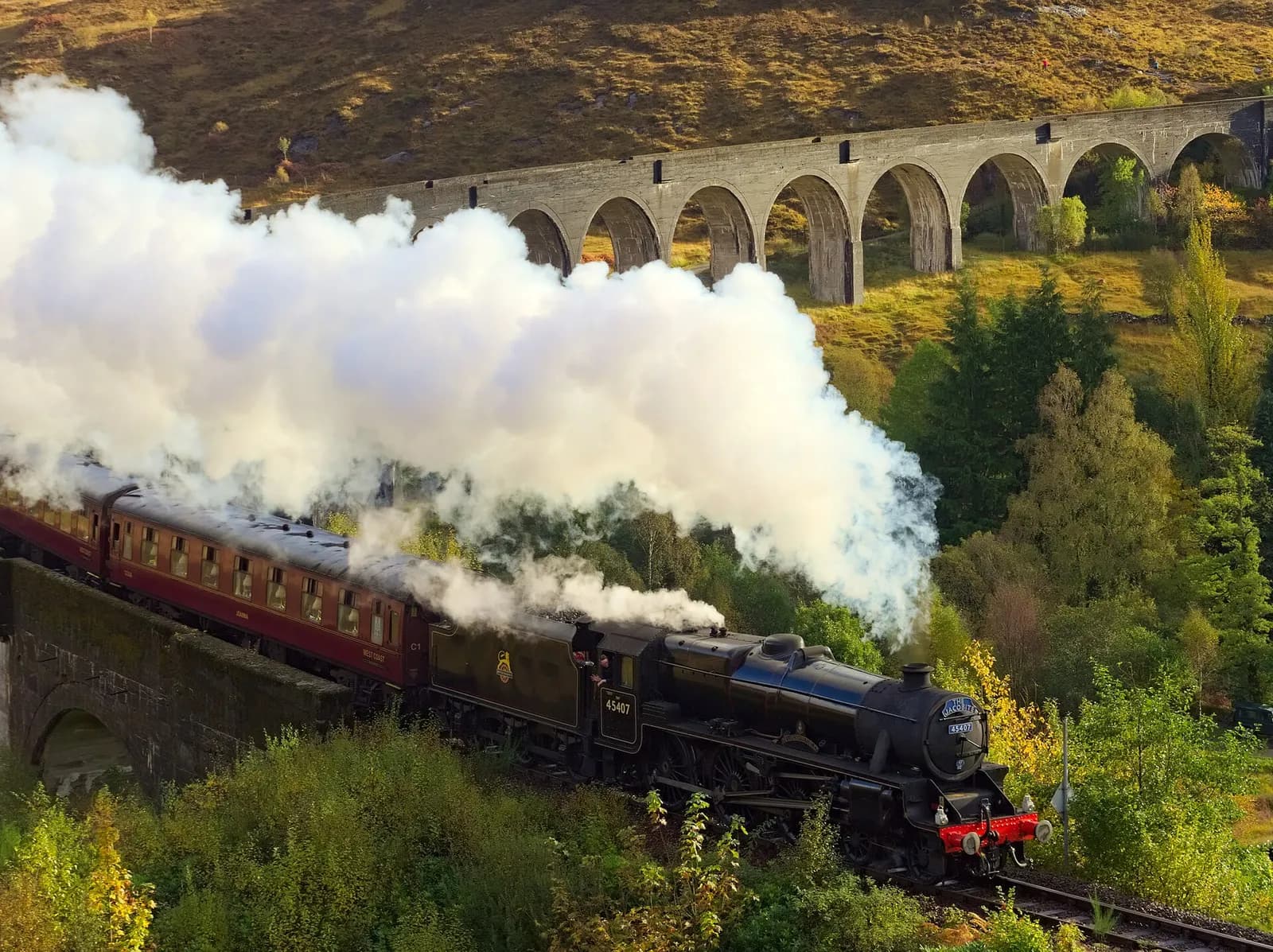
The shot is always the same and it never gets old: a scarlet locomotive trailing steam, curving left across a long viaduct, with a loch and a mountain behind it. That is the Glenfinnan Viaduct, carrying the West Highland Line between Fort William and Mallaig, at the head of Loch Shiel in Lochaber.
It appears repeatedly across the Harry Potter films and became the series' visual shorthand for the journey to Hogwarts — most famously in Chamber of Secrets, where Ron and Harry chase the train in a flying Ford Anglia, and again in Prisoner of Azkaban and Half-Blood Prince. Unlike most film locations, this one is a functioning piece of national infrastructure: trains cross it several times a day, every day, whether or not anyone is filming.
Concrete Bob's bridge
The viaduct was built between 1897 and 1901 by the contractor Robert McAlpine, universally known as Concrete Bob because of his conviction that mass concrete — then a distrusted, unfashionable material for major structures — was the right way to build in remote country where stone was expensive to dress and transport.
Glenfinnan was his argument in physical form: 21 arches, roughly 380 metres long and around 30 metres high at its tallest, curving on a radius through the glen, built almost entirely from unreinforced mass concrete poured on site. It is still doing its job 125 years later, which rather settles the debate.
There is a long-running local story that a horse and cart fell into one of the hollow piers during construction and were sealed in. A radar survey in the 1990s found nothing in the viaduct's piers, though remains of a horse and cart were later located in a pier of another McAlpine viaduct nearby at Loch nan Uamh. The legend attached itself to the wrong bridge.
The train is real, and you can ride it
The locomotive in the films is a real working steam engine, and the route it runs is a real scheduled service. The Jacobite, operated by West Coast Railways, runs steam-hauled tourist trains between Fort William and Mallaig across the viaduct, generally from around April to October, with one or two return workings a day in high season.
It is a genuine 84-mile round trip through some of the best scenery in Scotland — past Ben Nevis, along Loch Eil, over Glenfinnan and down to the fishing harbour at Mallaig — and it sells out months in advance. You can also cross the viaduct far more cheaply on ScotRail's ordinary diesel service on the same line, which is a perfectly good way to see it if steam is not the point for you.
Note that riding across the viaduct means you cannot see the viaduct. For the postcard shot you need to be standing on the hillside instead.
Where the photograph is taken from
The classic angle is from the Glenfinnan Viaduct Trail, a marked footpath climbing from the car park at the Glenfinnan Visitor Centre. It is a fifteen-to-twenty-minute walk uphill on a rough path to a viewpoint that puts you level with the arches and looking down the curve, with Loch Shiel behind.
This has become a genuine crowd-management problem. On a summer day with a scheduled steam crossing, several hundred people gather on the hillside, the car parks fill by mid-morning and the single-track A830 backs up. The National Trust for Scotland, which runs the visitor centre, publishes the steam timings and asks visitors to park only in designated areas — the verges are soft and blocking passing places on a Highland road is a serious matter, not an inconvenience.
The rest of Hogwarts, assembled from several places
Hogwarts itself is a composite of locations and models. Alnwick Castle in Northumberland supplied the flying lesson and Quidditch training courtyard in the first two films; Durham Cathedral's cloisters served as corridors and the quad where Harry releases Hedwig; Gloucester Cathedral's cloisters became more Hogwarts corridors; Christ Church, Oxford provided the staircase and the model for the Great Hall, which was then built as a set at Leavesden.
Platform 9¾ is King's Cross, though the arch used on camera is between platforms 4 and 5 rather than 9 and 10, which had no suitable brickwork. The station now has a marked trolley in the concourse for photographs — installed for tourists, not used in the films.
Visiting the location
- Where
- Glenfinnan Viaduct, Glenfinnan, Lochaber, Scottish Highlands, on the A830 between Fort William and Mallaig.
- Getting there
- About 30 minutes' drive west of Fort William on the A830. Glenfinnan has its own station on the West Highland Line, so you can arrive by train and walk to the viewpoint.
- Access
- Free and open. The viewpoint is reached on foot from the National Trust for Scotland car park at the Glenfinnan Visitor Centre (parking charged). The trail is rough, uphill and often muddy.
- Check the Jacobite steam timetable before you go — without a steam crossing you are photographing an empty bridge.
- Arrive at least an hour before the crossing in summer. Car parks fill early and there is nowhere legal to park on the road.
- Wear boots. The path is unsurfaced and the hillside is usually wet.
- The Glenfinnan Monument and Loch Shiel are a few minutes away on the same site and are worth the detour for their own history.
Frequently asked questions
Can you ride the Hogwarts Express train?
You can ride the Jacobite, the steam service that crosses the Glenfinnan Viaduct between Fort William and Mallaig from roughly April to October. It is the same route and the same viaduct; book months ahead.
Where do you stand to photograph the Glenfinnan Viaduct?
On the Glenfinnan Viaduct Trail, a fifteen-to-twenty-minute uphill walk from the National Trust for Scotland visitor centre car park.
Is the Glenfinnan Viaduct free to visit?
Yes, the viewpoint and trail are free. Parking at the visitor centre is charged, and it is the only legal place to leave a car nearby.
Is Hogwarts a real castle?
No. Hogwarts is a composite of Alnwick Castle, Durham Cathedral, Gloucester Cathedral and Christ Church Oxford, combined with sets at Leavesden Studios and digital models.