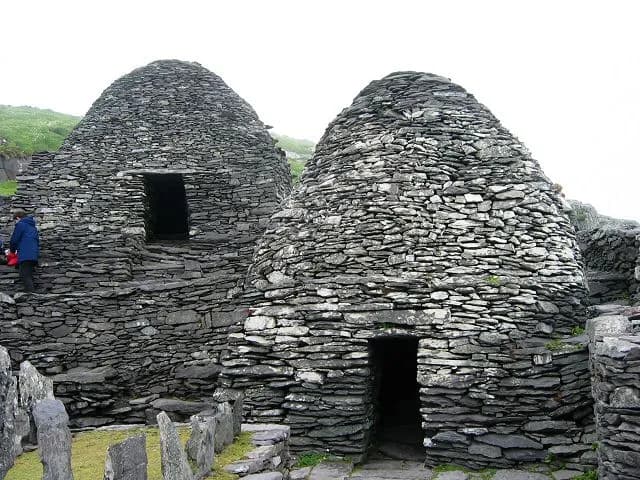
Ahch-To, the island where Rey finds Luke at the end of The Force Awakens and where most of The Last Jedi takes place, is Skellig Michael — Sceilg Mhichíl — a jagged twin-peaked rock in the Atlantic about eleven kilometres off the coast of County Kerry in Ireland.
The stone huts Luke lives among are not set dressing. They are a genuine early-medieval monastic settlement, built by monks somewhere around the sixth to eighth centuries, and the site has been a UNESCO World Heritage Site since 1996. This is one of the very few filming locations where the location is considerably more remarkable than the film that made it famous.
The monastery
The settlement sits on a shelf near the top of the larger peak, roughly 180 metres above the sea, and consists of six corbelled drystone beehive huts (clocháin), two oratories, stone crosses and terraced garden plots. It was built and occupied by a very small community of monks — probably no more than a dozen at a time — who lived there for something like six centuries before withdrawing to the mainland, likely in the twelfth or thirteenth century.
The construction is drystone throughout, without mortar, and the huts have remained watertight for well over a thousand years on an exposed Atlantic rock. The stairways cut into the cliffs are original monastic work.
The island is also a major seabird colony, with large numbers of puffins in the breeding season, along with gannets on the neighbouring Little Skellig, storm petrels and Manx shearwaters. The puffins in The Last Jedi are real; the porgs were designed partly because the puffins were impossible to keep out of shots.
Getting there is the hard part
Access is tightly controlled and genuinely difficult. Only a limited number of boat operators hold licences to land passengers, the total number of visitors permitted ashore each day is capped, and the landing season runs approximately from mid-May to the end of September. There is also a minimum age of 14 for landing.
Crossings are cancelled frequently. The landing is onto a small concrete pier with no harbour, and Atlantic swell makes it unsafe more often than not — operators commonly lose a substantial share of scheduled days to weather, sometimes deciding at the pier or turning back mid-crossing. Bookings open months ahead and sell out.
There is a second option: eco tours that circle the islands without landing. They run in conditions that would cancel a landing, they are cheaper, and they still give you the Skelligs and the gannet colony. If seeing the island is the goal rather than standing on it, this is the reliable choice.
The climb, which is not a tourist attraction
From the pier, reaching the monastery means climbing 618 uneven stone steps cut into the cliff, with no handrails, no barrier and drops of well over a hundred metres. There is no shelter, no water, no toilet and no shop on the island. Guides are stationed on the site but there is no rescue infrastructure.
Accidents and fatalities have occurred, both on the climb and during the transfer between boat and pier, which is itself hazardous in any swell. The Office of Public Works, which manages the island, is direct about this in its guidance, and operators advise against the trip for anyone with heart or respiratory conditions, mobility or musculoskeletal problems, vertigo or a history of seizures.
Around two and a half hours ashore is typical: roughly an hour up, time at the monastery, an hour down. That is the whole visit.
Not everything was shot on the island
Because access is so constrained, only limited filming took place on Skellig Michael itself — the arrival at the end of The Force Awakens and some Last Jedi work. For the bulk of the Ahch-To sequences in The Last Jedi, the production built a replica of the island's huts and terraces at Ceann Sibéal on the Dingle Peninsula, on the Kerry mainland, and shot there.
Malin Head in County Donegal, the northernmost point of the Irish mainland, was also used for Ahch-To coastline in The Last Jedi. The Skellig itself supplies the silhouette and the establishing shots — which is, in fairness, what makes the place.
Visiting the location
- Where
- Skellig Michael, off the Iveragh Peninsula, County Kerry, Ireland. Boats leave from Portmagee, Ballinskelligs, Caherdaniel and Derrynane.
- Getting there
- Portmagee is the main departure point, roughly a 90-minute drive from Killarney. Crossings take about 45 minutes.
- Access
- Landing tours run roughly mid-May to end of September only, with a capped daily number of visitors across a small number of licensed operators, and are frequently cancelled by sea conditions. Minimum age 14. Non-landing eco tours run more reliably.
- Book months in advance, and build slack into your trip — assume your chosen day may be cancelled.
- Do not attempt the climb if you have vertigo, mobility problems or poor balance. There are 618 steps, no handrails, and the drops are lethal.
- Take water, waterproofs and sturdy boots. There are no facilities of any kind on the island.
- If landing is cancelled, take the eco tour. The Skelligs from the water are still extraordinary.
Frequently asked questions
Can you visit Luke Skywalker's island?
Yes, but with difficulty. Skellig Michael takes a capped number of visitors a day, by licensed boat only, from around mid-May to the end of September, with a minimum age of 14. Crossings are cancelled often because of Atlantic swell.
How hard is the climb on Skellig Michael?
618 uneven stone steps with no handrails and sheer drops. It is genuinely dangerous — accidents and fatalities have occurred — and it is unsuitable for anyone with vertigo, mobility difficulties, or heart or respiratory conditions.
Are the stone huts real?
Yes. They are a drystone monastic settlement built somewhere around the sixth to eighth centuries and occupied for roughly six hundred years. The island is a UNESCO World Heritage Site.
Was The Last Jedi filmed on Skellig Michael?
Only partly. Because access is so restricted, most Ahch-To scenes used a full replica of the huts built at Ceann Sibéal on the Dingle Peninsula, plus coastline at Malin Head in Donegal.