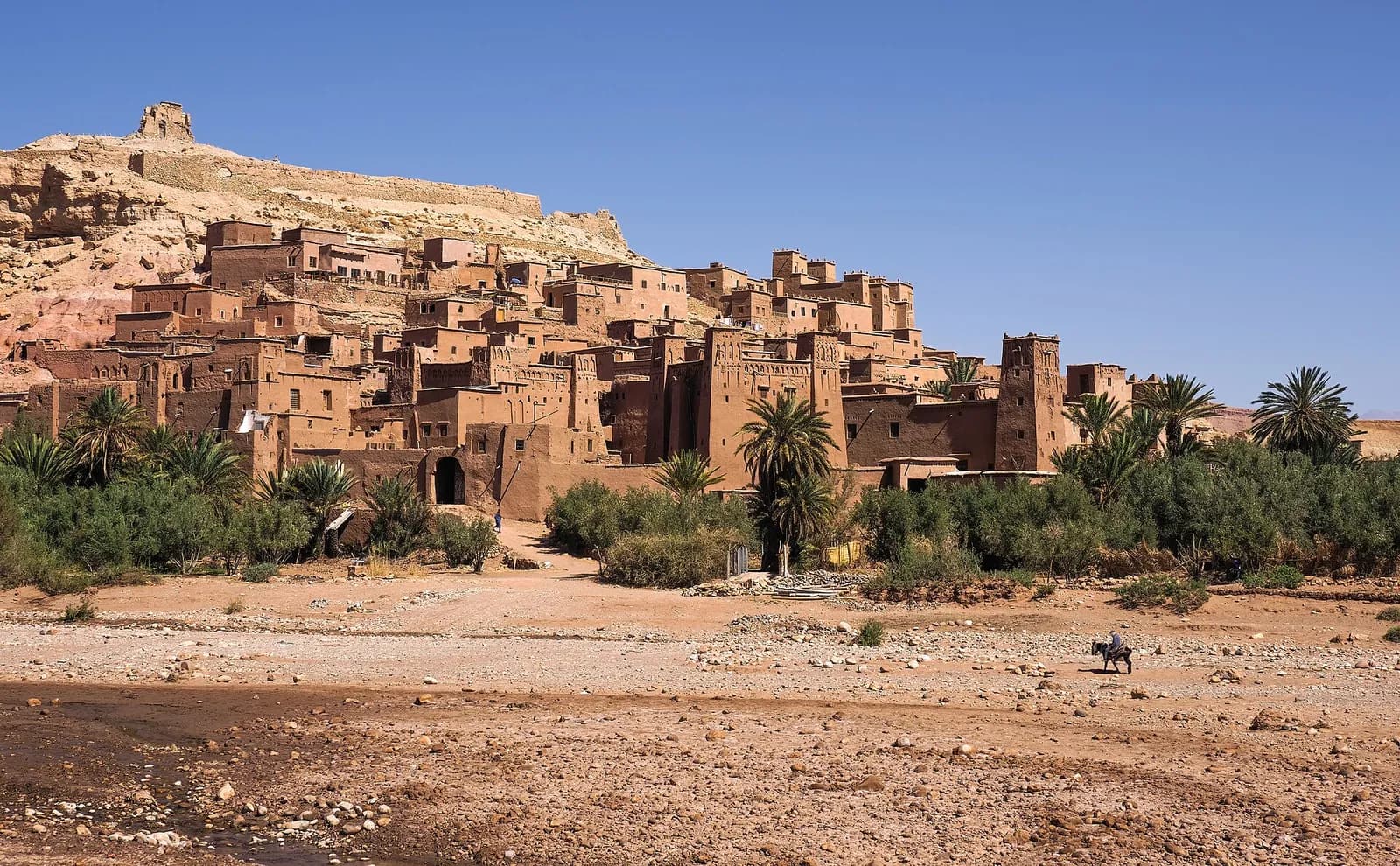
Gladiator's Roman province of Zucchabar — where Maximus is sold into slavery and fights his first bouts in a provincial arena — is the ksar of Aït Benhaddou in southern Morocco, on the edge of the High Atlas near Ouarzazate. It is a real fortified village of earthen construction, a UNESCO World Heritage Site since 1987, and it has been used by film productions for over half a century.
The Colosseum sequences are a different country. Ridley Scott's crew built a partial full-scale Colosseum at Fort Ricasoli in Malta and completed the upper tiers digitally. Rome itself appears in the film almost entirely as Malta plus visual effects.
The ksar
Aït Benhaddou is a ksar: a fortified village of packed-earth buildings clustered inside defensive walls, built in the local pisé technique of rammed earth and straw. It sits on a hillside above the Ounila River, and it was a stop on the caravan route that carried salt and gold between the Sahara and Marrakech.
Earthen architecture requires constant maintenance, and much of what stands has been repaired or rebuilt over the last century, some of it by film productions that needed particular structures and left them in place. Most of the families who once lived inside the walls have moved to the modern village across the river; a small number of households remain in the ksar itself.
Scott used the site's silhouette and its interior lanes for Zucchabar, and built the provincial arena — a small, rough, wooden-galleried bowl, deliberately unlike the Colosseum — on the flat ground nearby.
Ouarzazate, the desert film capital
Ten miles down the road, Ouarzazate has been a film production centre since the 1960s and is locally nicknamed Ouallywood. Atlas Studios there is one of the largest studio facilities in the world by land area, and standing sets from decades of productions remain on the site.
The list of films shot in and around Ouarzazate is extraordinary: Lawrence of Arabia, The Man Who Would Be King, The Last Temptation of Christ, The Mummy, Kundun, Kingdom of Heaven, Babel, Prince of Persia, and — most visibly for a modern audience — a great deal of Game of Thrones, where Aït Benhaddou served as Yunkai and the surrounding country as Essos.
The practical consequence is a deep local crew base. Morocco supplies experienced production personnel, extras and horse units, and that infrastructure is a large part of why Scott chose it over building in Europe.
Malta, and the Colosseum that is a third real
The Roman sequences were shot at Fort Ricasoli in Kalkara, Malta, an enormous 17th-century Hospitaller fortification whose parade ground could take a large build. The production constructed roughly the lower third of the Colosseum at full scale — about 15 to 16 metres high — with the remaining tiers and the crowd added digitally by Mill Film, work which won the film an Academy Award for visual effects.
Fort Ricasoli has remained a film location since: Troy, Assassin's Creed, Game of Thrones and the Gladiator sequel have all used it. The fort is in poor structural condition in places and access is restricted, so it is not straightforwardly visitable in the way Aït Benhaddou is.
The opening battle against the Germanic tribes was filmed somewhere else again — in Bourne Wood, a Forestry Commission plantation near Farnham in Surrey, England. Scott has returned to the same wood repeatedly across his career.
The wheat field
The recurring image of Maximus walking through a field of wheat, brushing the ears with his hand, was shot in Surrey near Bourne Wood, close to the opening battle location — not in Italy or Spain as the imagery implies. It is a small thing, but it is characteristic of how the film is put together: almost none of it was shot where it is set.
Visiting the location
- Where
- Ksar of Aït Benhaddou, Ouarzazate Province, Morocco, on the N9 road between Marrakech and Ouarzazate.
- Getting there
- About four hours from Marrakech by road over the Tizi n'Tichka pass, or 30 minutes from Ouarzazate. Grand taxis and organised day trips run from both.
- Access
- Free to enter and walk through; it is an inhabited village and a World Heritage Site, not a ticketed attraction. A few of the houses charge a small fee to climb to their roof terraces, and there is a charge at the granary at the summit.
- Cross the river and climb to the agadir at the top — the view back over the ksar and the valley is the shot from the film.
- Early morning and late afternoon light are dramatically better on earthen architecture, and the coach parties come at midday.
- Combine it with Atlas Studios in Ouarzazate if the film history is the draw; standing sets from several productions remain.
- It is someone's home. The upper village is largely uninhabited, but people do live here — ask before photographing doorways.
Frequently asked questions
Where was Gladiator's arena filmed?
The provincial arena at Zucchabar was built near the ksar of Aït Benhaddou in Morocco. The Colosseum sequences were filmed at Fort Ricasoli in Malta, where the lower third was built at full scale and the rest added digitally.
Can you visit Aït Benhaddou?
Yes. It is an inhabited UNESCO World Heritage village, free to walk through, about four hours from Marrakech or thirty minutes from Ouarzazate.
Was Gladiator filmed in Rome?
Essentially no. Rome was recreated in Malta with digital extensions; the film's location work was in Morocco, Malta and England.
Where was the wheat field scene in Gladiator filmed?
In Surrey, England, near Bourne Wood outside Farnham — the same area as the film's opening battle sequence.