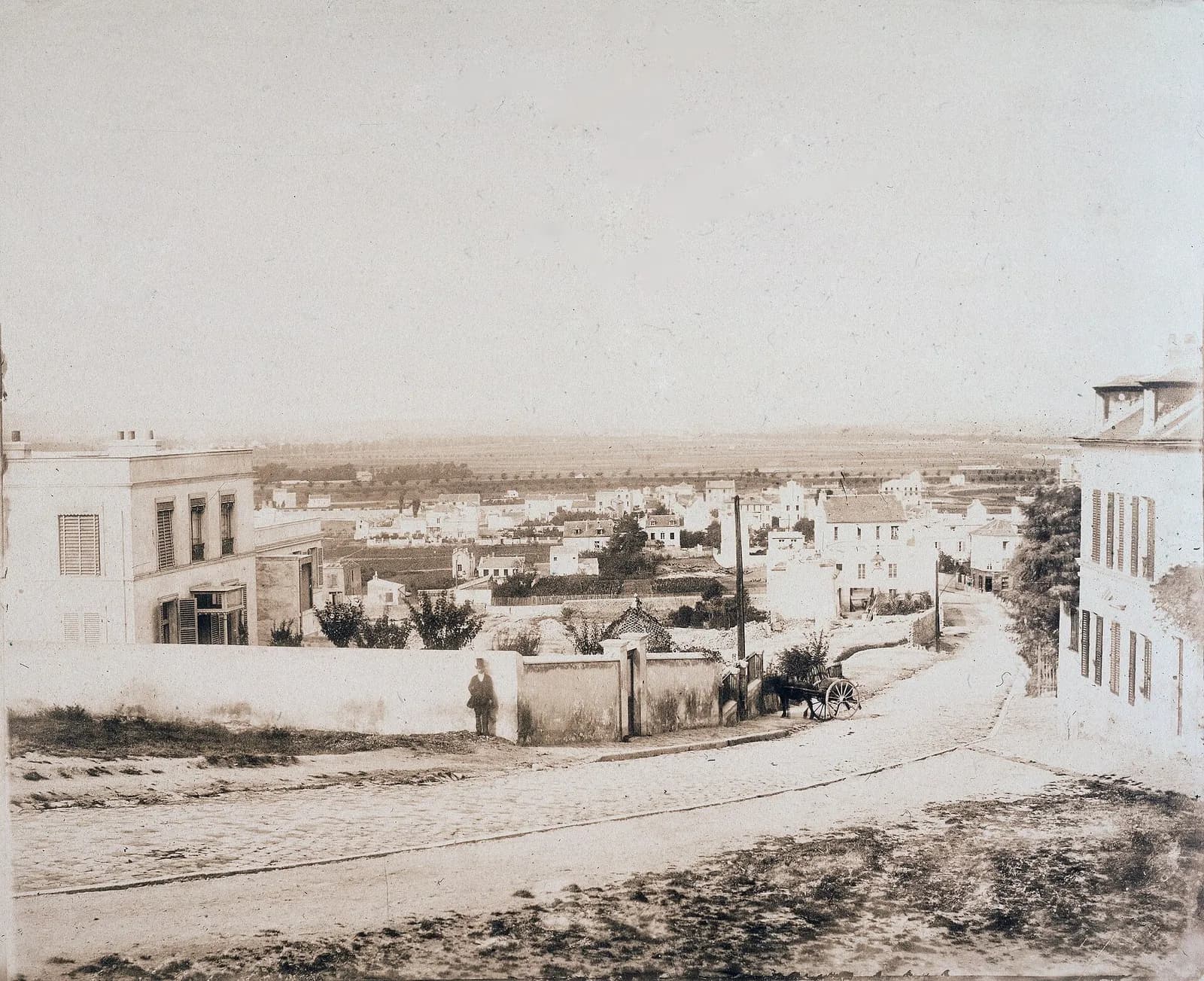
Amélie's Paris is Montmartre, the hilltop 18th arrondissement neighbourhood built up around the Sacré-Cœur basilica, filmed largely on its real, steep, cobbled streets — Rue Lepic above all, where much of the film's geography is anchored. The café where Amélie works, the Café des Deux Moulins, is a real, still-operating café on that street.
What is not entirely real, in the strict sense, is the colour. Jean-Pierre Jeunet and his cinematographer graded the whole film toward saturated greens and golds in post-production, and in places digitally removed modern clutter — graffiti, satellite dishes, anachronistic signage — to heighten Montmartre's storybook quality. The streets are real; the specific glow is a considered effect layered onto them.
Café des Deux Moulins
The café at 15 Rue Lepic was a real, ordinary neighbourhood café before the film, serving the working Montmartre streets rather than tourists. After Amélie's release it became one of the most visited film-tourism cafés in Paris, and the current operators have leaned into that history without turning the place into a pure prop — it still functions as a working café, serving the crème brûlée Amélie is famously particular about, alongside standard bistro fare.
Expect a busier, more tourist-oriented room than the film's version of it, particularly around midday, and expect the interior fittings and colour scheme to differ somewhat from what was styled for the shoot.
Rue Lepic and the rest of the hill
Rue Lepic climbs steeply from Boulevard de Clichy up toward the Moulin de la Galette windmill near the top of Montmartre, and the film uses its length and its market-street character — fruit stalls, small shops, narrow pavements — repeatedly as Amélie moves around her neighbourhood.
The grocer's shop where the difficult Monsieur Collignon works, and the apartment building where Amélie lives, are both drawn from real addresses in the surrounding streets, though as with most residential exteriors used in film, interiors were built or filmed in a mix of real rooms and set dressing.
The Sacré-Cœur basilica, at the top of the hill, appears as Montmartre's obvious visual anchor throughout, exactly as it does for anyone walking the neighbourhood in person.
The colour grade, and why the streets look different in person
Jeunet has spoken about wanting Montmartre to feel like a slightly heightened, storybook version of itself rather than a strictly documentary one, and the production's colour work — pushing greens and yellows, softening harsher modern details — was central to achieving that. Some shots also removed contemporary signage or graffiti digitally to strip out anything that broke the mood.
This means visitors sometimes arrive expecting the exact saturated glow of the film and find, reasonably, an ordinary if very handsome Parisian hill neighbourhood in daylight. The streets, the buildings and the café are all real; the specific light is a post-production choice, most visible at dusk or under overcast Paris skies rather than being achievable simply by standing in the right spot.
Visiting the location
- Where
- Café des Deux Moulins, 15 Rue Lepic, Montmartre, 18th arrondissement, Paris.
- Getting there
- Blanche or Abbesses Métro stations (Line 2 and Line 12 respectively) are both a short walk from Rue Lepic.
- Access
- A public street and a working café, open to anyone during normal café hours. No booking is typically needed outside peak tourist times.
- Walk the full length of Rue Lepic uphill toward the Moulin de la Galette rather than just stopping at the café — the street itself is most of the film's geography.
- Visit the café outside midday and early evening for a quieter table.
- Climb to Sacré-Cœur at the top of the hill for the wide Paris view that anchors the neighbourhood in the film.
- Expect ordinary daylight colours rather than the film's graded glow — it is a real neighbourhood, not a set.
Frequently asked questions
Is the café from Amélie a real café?
Yes. The Café des Deux Moulins at 15 Rue Lepic in Montmartre is a real, still-operating café, and has been one of the most visited Amélie filming locations since the film's release.
Was Amélie's Paris digitally altered?
Yes, in part. The film was colour-graded toward saturated greens and golds, and some shots had modern clutter like graffiti or satellite dishes digitally removed to heighten the neighbourhood's storybook look.
Where is Amélie's Paris neighbourhood?
Montmartre, the hilltop 18th arrondissement built up around the Sacré-Cœur basilica, filmed largely along and around Rue Lepic.
Can you visit the streets from Amélie?
Yes, freely — Montmartre is an ordinary, walkable Paris neighbourhood, and nearly all of the film's exteriors are real, publicly accessible streets.